


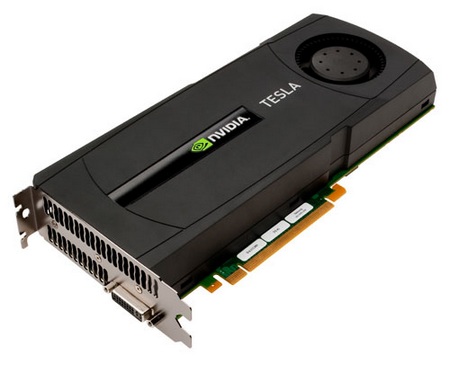
 The Tesla 20-series includes the Tesla C2050 and Tesla C2070 GPU Computing Processors, which is for workstation configurations and the Tesla S2050 and S2070 for for cluster and datacenter deployments. The former two are single GPU PCI-Express Gen-2 cards with up to 3GB/6GB of GDDR5 memory offering double precision performance in the range of 520GFlops – 630 GFlops while the latter two are Four Tesla GPUs in a 1U system product with up to 12GB/24GB GDDR5 memory providing 2.1 TFlops – 2.5 TFlops performance.


Intel Research showed me a demo of their Platform Power Management system. Essentially, they're applying the smart, quick, hardware level idling you find on a CPU to many system parts. The result: systems that idle at 10x less juice.
The tech is applied to things like USB ports, which in 3.0, will go from polling (clock based, always checking) devices to being managed via events, so they can sleep whenever not being used. And graphics, when the page isn't changing, can be run out of a frame buffer so the GPU and video RAM can sleep. When I say more sleep, I mean for additional milliseconds or longer. This adds up, over the course of a day when people stop to read or step away from their computers. In the past, the OS controlled the power savings, and that required power to process in turn, so you were using the system's power to manage power, keeping those other components from ever really turning off. By doing power management with more granularity, in hardware and software together, you can switching things on/off fast enough to fit in lots of "naps" and you can also do it with less processing overhead.
I'm excited for this tech to go everywhere where there's a chip.


AMD announced the AMD ATI The Radeon HD 4770 has aso support for HDMI, picture-in-picture (PiP) and of course DirectX 10.1. The new GPU will be launched with a price as low as $99.


